
Chained dogs.
The power of Classical Conditioning.

A story about the chaining of dogs.

The dog featured in the photo above is not the dog featured in this story.
I know of a dog, a beautiful German Shepherd, belonging to neighbors.
I first saw the dog as a cute fluffball of a dog at maybe 3 months old.
It lived in a kennel at the side of the house.
I saw the puppy chained up at some point after its arrival on a chain maybe, 20 feet in length. The puppy lived in a large fenced yard, so I was not sure why he was chained too.
As the months went by, I noticed the dog would lunge at every car, truck, walker, or dog that went by on the road, which ran parallel to the perimeter fence.
Yet the chain halted him from running fully to the fenceline, thus stopping him from fully investigating the trigger, whether it was a truck or a dog.
At first, the behavior was one of fear; his little puppy body would curl, head lowered, with his tail tucked between his legs as the loud trucks would speed by.
Then, as he grew, so did his demeanour; he would bark frantically in the rapid staccato bark so typical of German Shepherds. Running to the end of the chain only to be abruptly stopped, causing him to rear up as he hit the end, sometimes with considerable force.
He would then run, creating an arc as he ran backwards and forwards, trying to get to the trigger that spooked him.
I watched this conditioning over the years. I could hear him barking at night, too. He was an outside dog, adopted to do one thing- guard.
Maybe his ‘training’ was not consciously enacted by his owners. Rather, the chaining did the training.
It slowly conditioned this intelligent young dog that he was to stay within a particular area and not leave it- ever.
Every time I walked by with my dogs, I would see him race backward and forward, barking frantically on the chain. I also noticed that he had learned he could not go past the length of the chain and so no longer ran to the end of it, jerking on his neck.
He had created a trough in the dirt where he ran on the chain every day. His patterns of behavior were being shaped by the restrictions of the chain.
Then one day I walked by, and he was not on the chain.
I watched to see what he did.
He stayed within the area created by the chain and did not go beyond that.
The powerful effect of conditioning an animal using the environment is a hallmark of captivity, which is why we need to be mindful of how we keep or house our animals to ensure we are really meeting their needs appropriately.
For the last year, he has ventured past his conditioned arc and runs the property’s fence line reacting with every passing car, truck, dog, and person.
Does this new level of freedom now satisfy his needs?
Research conducted in the 1960’s by Scott & Fuller [1] illustrated the critical learning timeline in canines. Their exhaustive studies concluded that critical learning periods in canines occur very early in life, and without the exposure that is needed to facilitate normal neural and physiological growth, the canine suffers mentally and emotionally in later life.
As this dog received no enrichment in his critical early weeks of life, we can assume his behaviors will not go away, but rather his original frustrations will remain unmet and unresolved.
The abnormal responses or, as I call them, institutionalized stereotypic behaviors such as pacing, fence biting, barking incessantly, etc. is typical but should not be accepted as normal.
Puppies that are confined day in and day out ( think of all the dogs in shelters across the country or world) and do not receive adequate socialization do not have the reference points to ‘know’ how to respond to novel situations.
As Coppinger wrote, “Even if the impoverished pup gets taken to an enriched environment as an adult, it cannot learn to cope with that environment because it does not have the necessary cell connections. Once the dog gets to sixteen weeks, it has made (or has not made) just about all the social connections it is ever going to make.”[2]
But even more disturbing is that even if I try to talk to him, to reassure him as I walk by with my dogs, he makes no response to me, but rather continues in his repetitive barking and fencing dashing.
He shows no interest in engaging me or hearing my voice as I softly say hi. He is disengaged and only interested in the other dogs.
Even with his new ‘freedom,’ he is not able to break or ‘grow’ out of his early conditioning. And this is the critical point:
Dogs’ early learning absolutely forms their behavior.
How do they respond to external stimuli?
Do they even know?
A dog like this would be difficult to rehome if ever he were surrendered, as he is so lacking in social skills.
His perception of anything outside of his home is one of threat, not curiosity.
Environmental deprivation, such as this, is more common than not. Go anywhere in the world, and you will see animals in captivity living in impoverished environments. Whether it is horses stalled 24/7 or dogs chained or kenneled.
It is so common that it is normalized, but it is not normal. And as such, it is no wonder so many animals present with behavioral issues.
Many people lack the experience or knowledge to understand and read their animals correctly.
So, most dogs, like my neighbors, are assumed to be aggressive—especially when combined with breed stereotypes, whether they’re bulldog-type or shepherd-type breeds.
Unfortunately, our perceptions often reinforce this view.
Cultural acceptance of how animals are used and kept—whether they’re dogs, horses, pigs, or other domesticated animals is without regulation of any governing body. In some countries, if there are laws, there is a lack of enforcement. This is certainly true where I live in Northern New Mexico.
Many rural areas have animals contained in ways that lack enrichment. As a result, stereotypic behaviors emerge as the animals’ energy needs an outlet.
Dogs bark or howl, or chew up the dog house, or try to dig out.
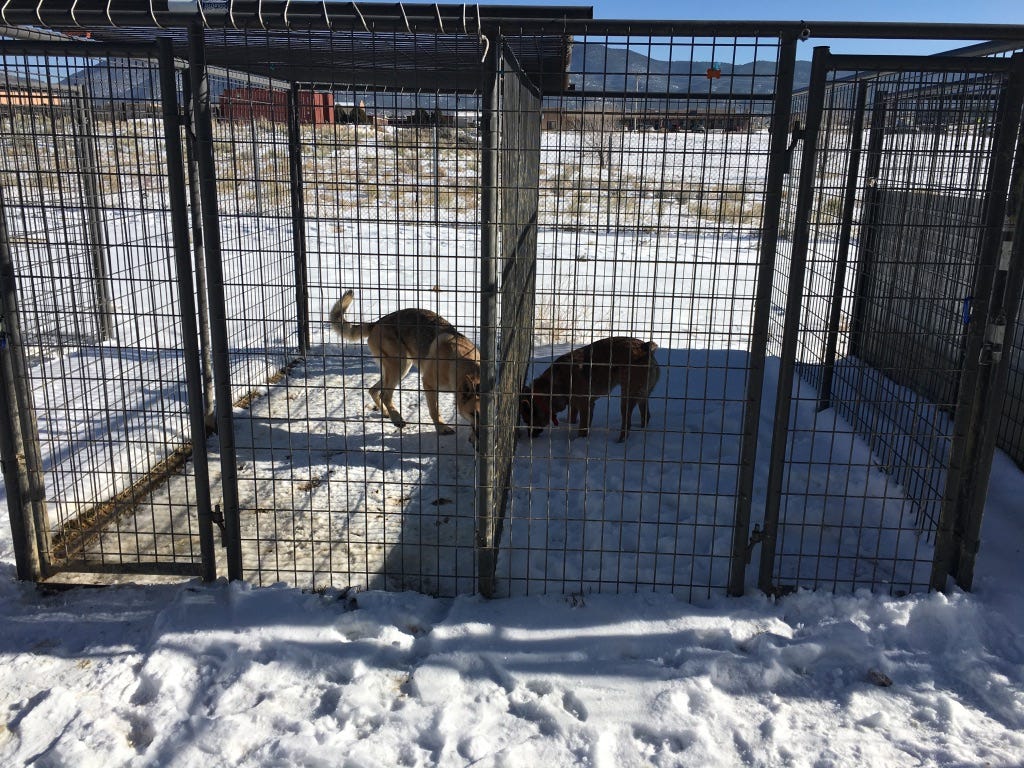
Kennels at the local shelter, dogs can spend the whole day in these standard-issue designed kennels. Other than each other there is little enrichment available.
Horses might push the fence line, crib, or stand around in a chronic state of depression.

We have normalized this as many of us do not necessarily know what depression is in an animal.
All of this is conditioned through association—classical conditioning. We may not realize it, but we’re pairing the environment and everything in it with behaviors as expressed by our animals. When a car drives by, it triggers a response.
With my neighbor’s puppy, he sees a big, noisy truck and barks in fear. But he is unable to explore the trigger because he is chained, so the fear keeps appearing every day without resolution. The barking develops into lunging and barking as the puppy grows. This is how so-called ‘bad’ behaviors start.
Environments need to be fulfilling beyond the needs of an animal. This dog has water, food, and a dog house. So, his needs are met physically, but what about his mind?
My work on developing my ©Circle Training is to take the concept of containing and training dogs using fencing to create an enclosure that is endless because it is a circle within a circle.
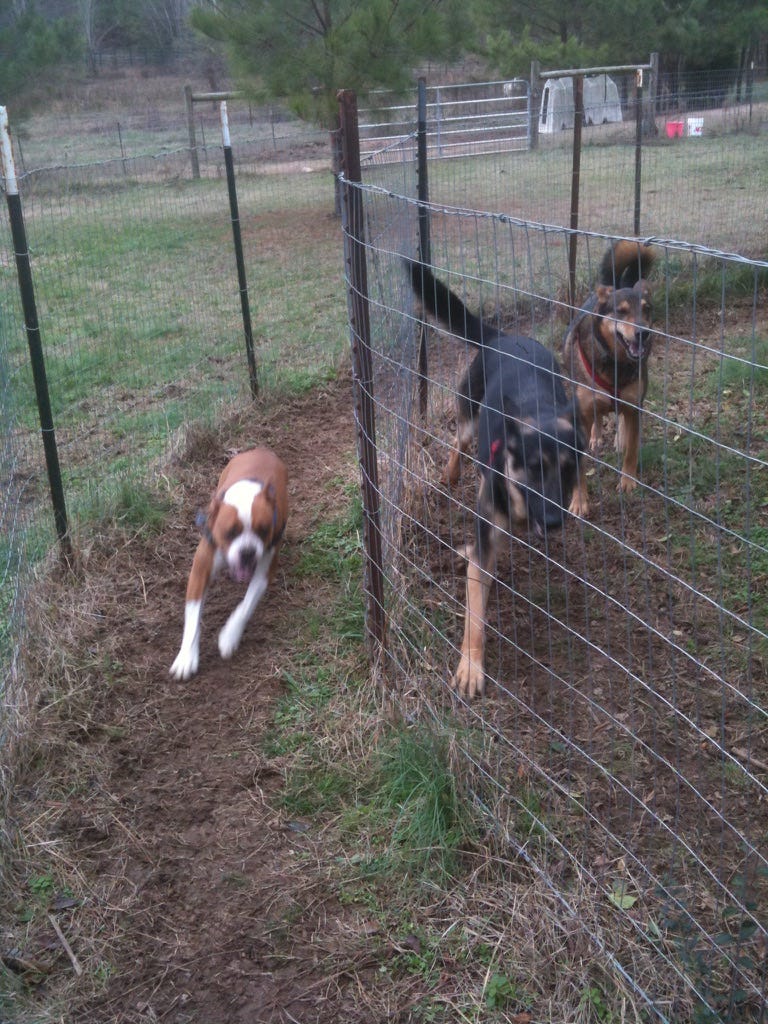
These dogs are playing chase in the circle. The bulldog is too aggressive to be in playgroups, so I use my circle to help her have valuable social interaction-safely- using my ©Circle.
The difference in how a dog behaves in my circle versus in a square kennel or yard is like black and white.
I should know! I have been working with dogs in circles for over 15 years now, as part of my mission to get dogs off chains.
And out of the kennels.
Every rescue, dog park, and commercial kennel should have circles to enrich their training practices and aid in hands-off socialization.
Dog fencing that is square or by design has corners and dead ends in the run, can trigger frustration, limit exploration, and is potentially boring.
If we have animals that we own, have adopted, rescued, or bought, considering where and how they live is part of our responsibility.
Deprivation in a social environment is like a child never learning to read; it stunts their growth and robs them of the opportunity to be the creative genius we all have the potential to be.
Our animals are no different.
Even with my neighbor’s dog, I am sure if they knew, he could be happier, being able to be walked on a leash off property or trained for fun, they would do it.
My ©Circle Training is the design that allows the relationship to develop beyond the chain or kennel. Because it is a hands-off learning and containment enclosure in one, and anyone can do it.
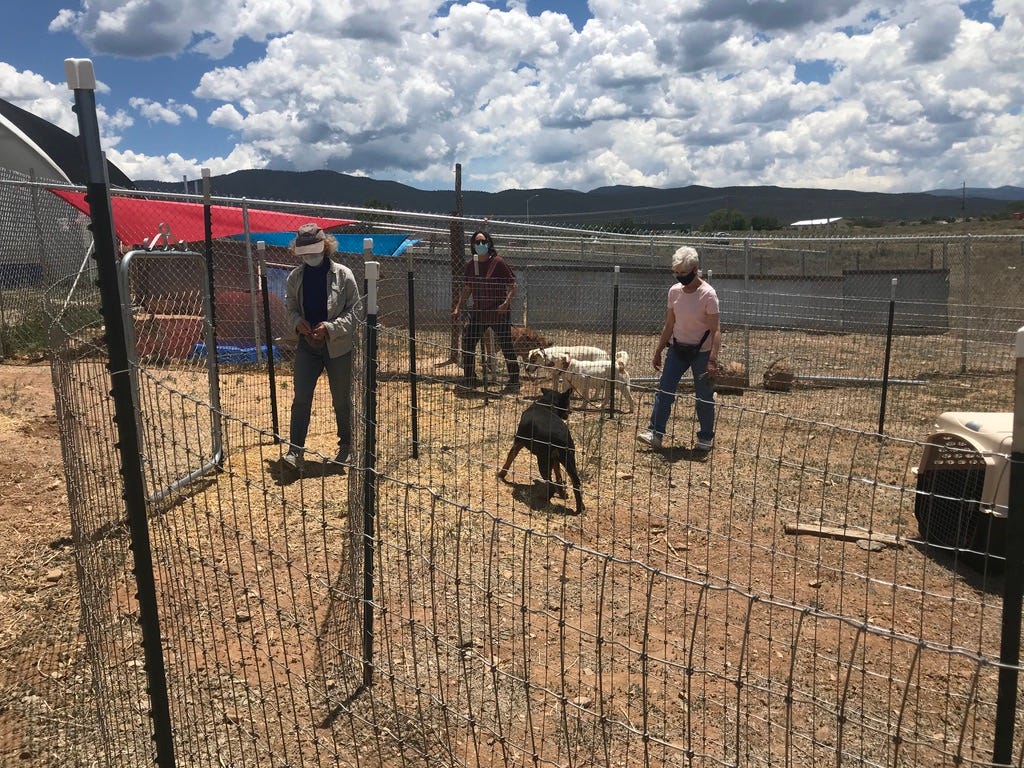
Volunteers working with shelter dogs using my ©Circle at Stray Hearts, Taos County, NM 2020.
If you would like to know more about how to change the environment where your dog lives, please reach out or book through my website:
www. https://janetrains.com/services/circle-training/
©Jane Gerard 2026.
[1] Genetics and the Social Behavior of the Dog. The Classic Study John Paul Scott and John L. Fuller 1965.
[2] “Dogs, A Startling New Understanding of Canine Origin, Behavior& Evolution.’ Dr. Raymond Coppinger and Lorna Coppinger 2001. Page 113 Developmental Environments.
My dog was badly traumatized by isolation for the first 6 months of her life. Neural pathways that created during that never developed as an consequence that isolation. She will never be normal. A client of Jane’s for the last 4 years, I now have some understanding of the science of the dog’s mind. Her Circle training addresses a dog’s needs and development in a way no other form can.